
The True KSA · Mining & Minerals
Discover Saudi Arabia’s mineral future
From geological data and exploration to responsible production, processing and global trade, understand the Kingdom’s mining landscape and the pathways shaping its next industrial chapter.
The True KSA is an independent information platform. It does not represent Saudi ministries and does not provide legal, tax, investment or engineering advice. Last checked: 15 October 2026
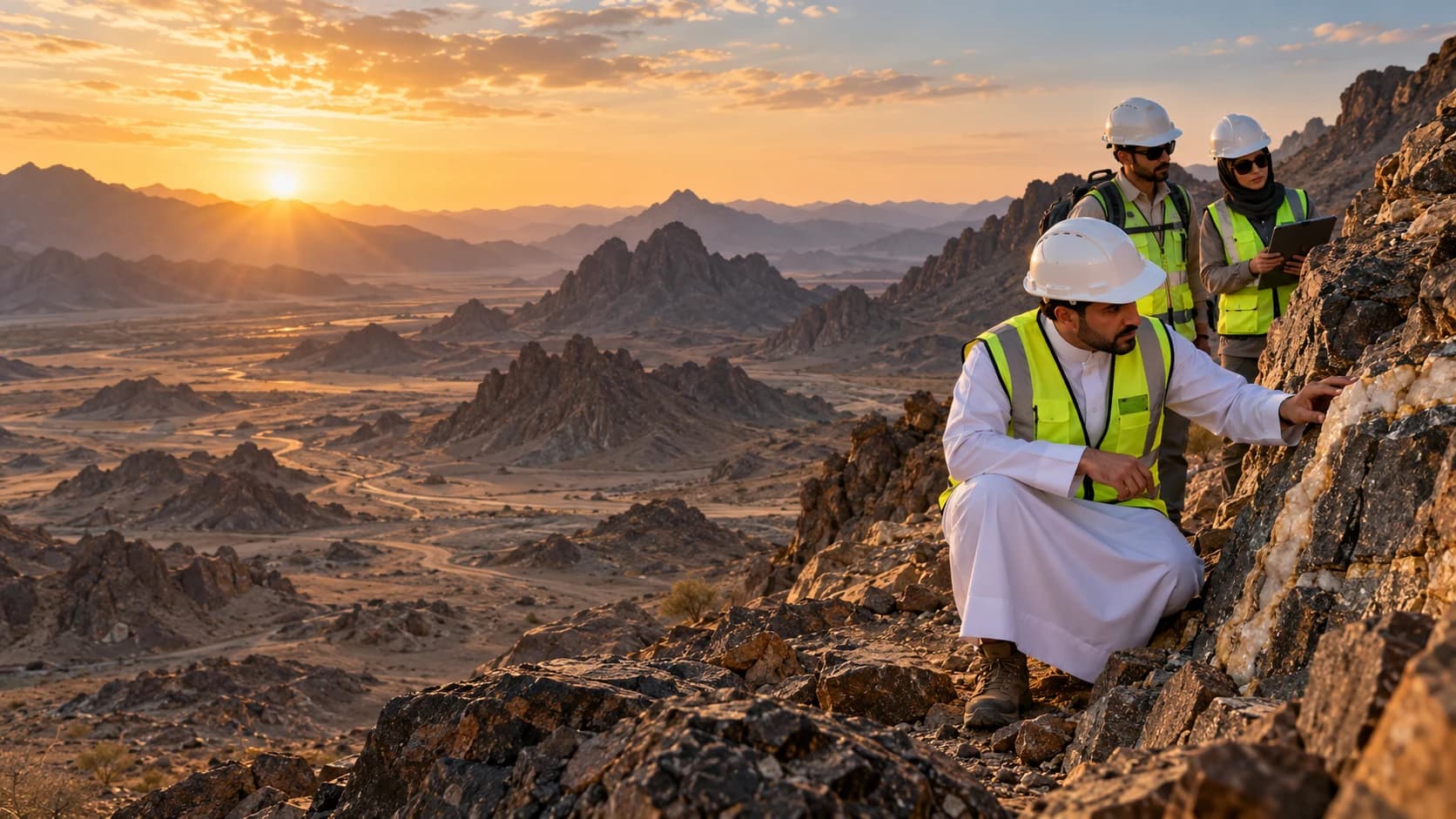
Illustrative image
Sector snapshot
Vision 2030 describes mining as the third pillar of national industrial growth. The figures below are dated official estimates and statistics — each with its own scope. None of them is a proven reserve, a production total or an investment offer.
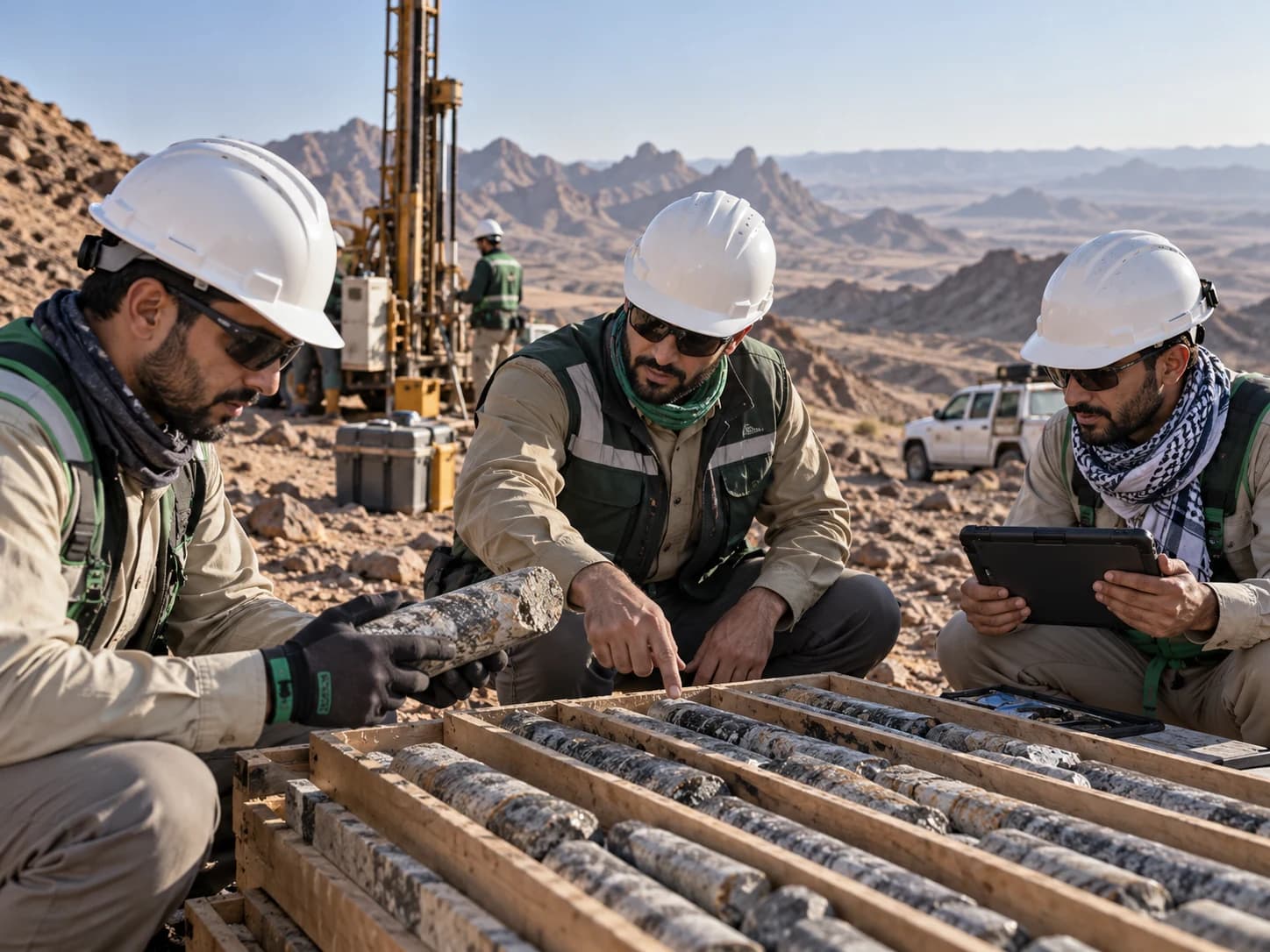 Saudi mineral landscapeGeology, resource categories and where official regional data lives.Explore this topic
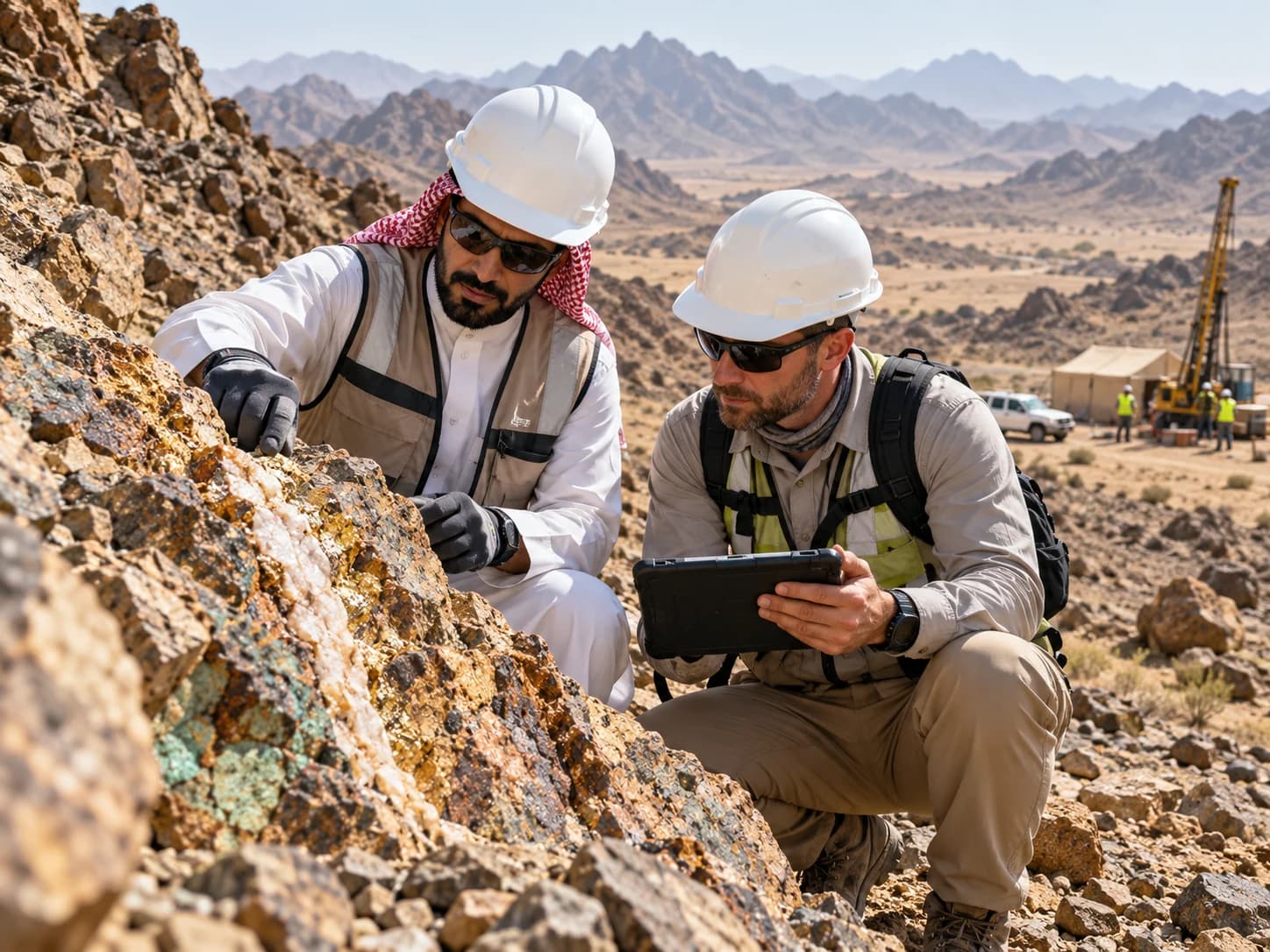 Investment pathwaysExploration, mine development, services, processing and downstream materials.Explore this topic
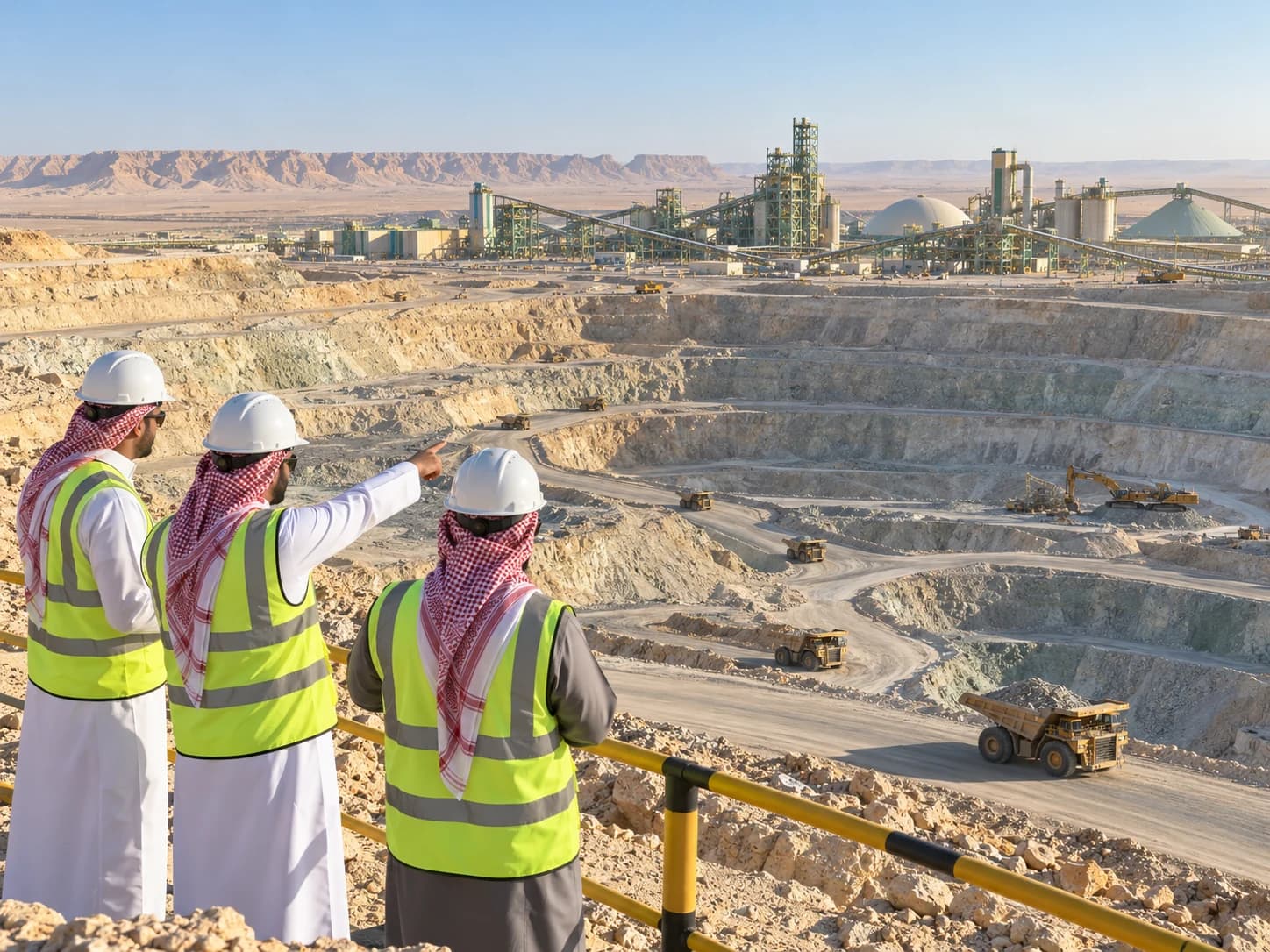 Licences and complianceWhere to verify current licence types, rounds and approvals.Explore this topic
 Institutions and networksRegulators, data providers, training bodies, forums and operators.Explore this topic
 Trade and logisticsProduct classification, export rules, routes and market data.Explore this topic
 Skills and responsible miningTraining, local capability, environment, rehabilitation and safety.Explore this topic


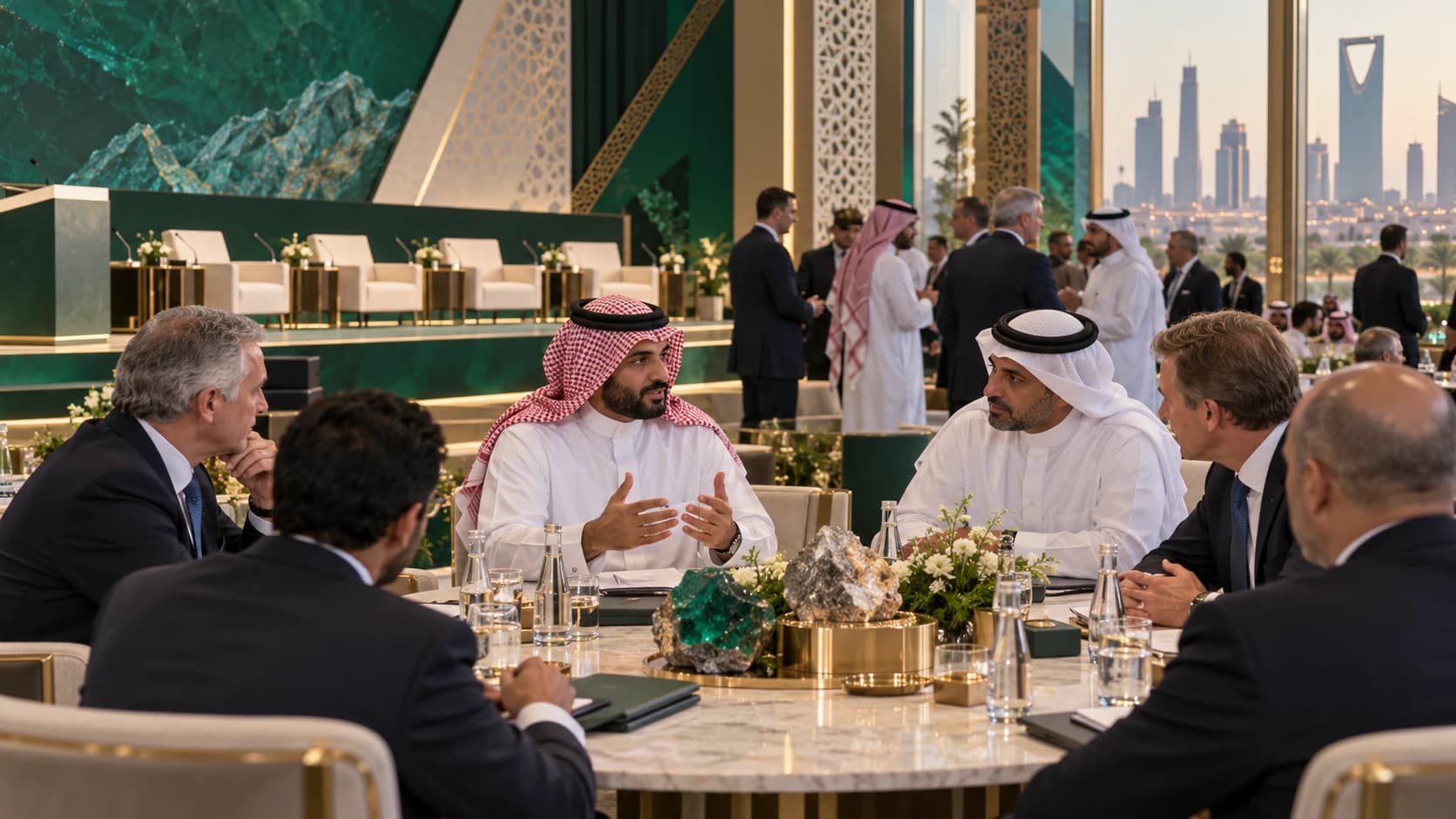
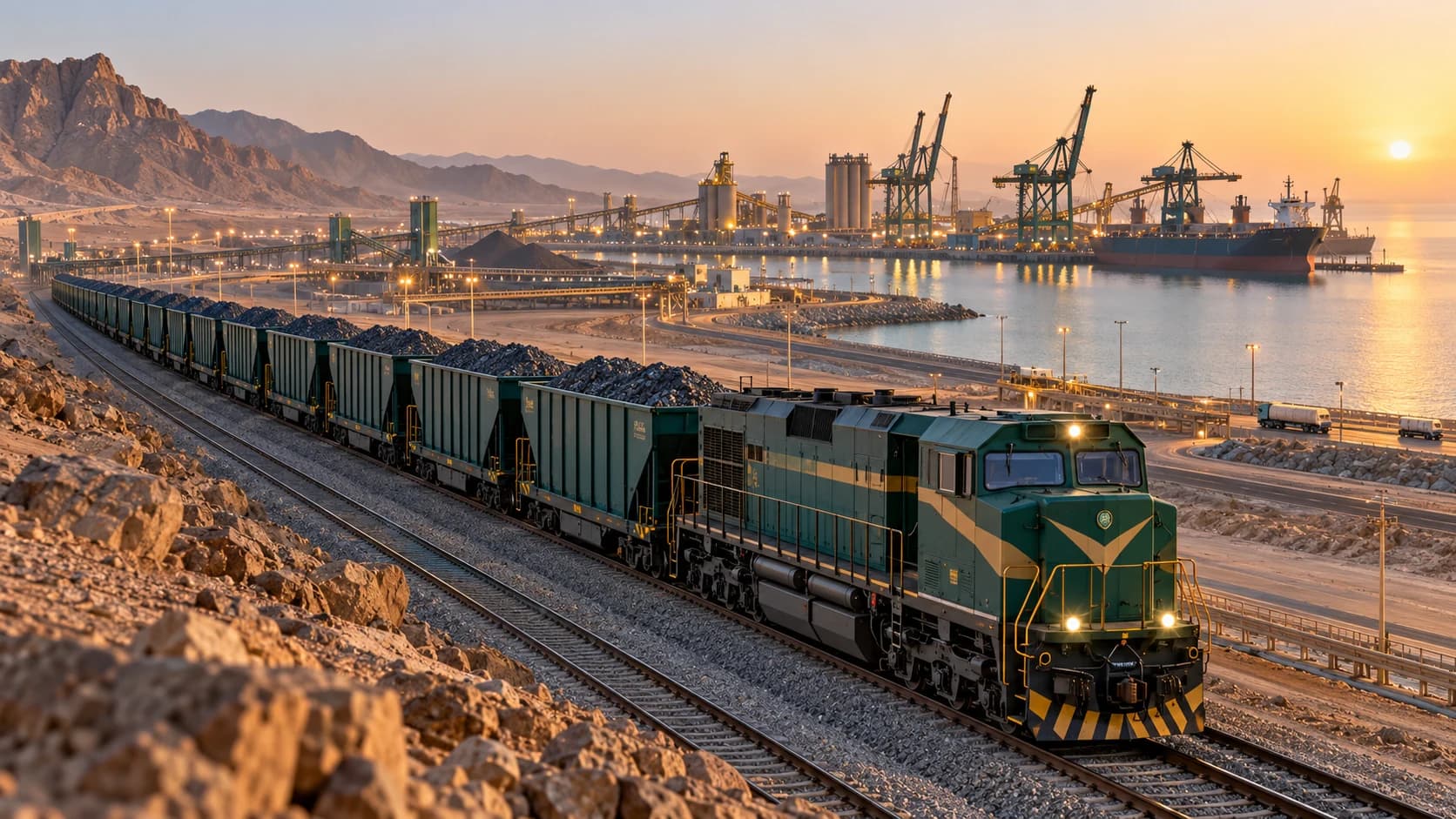
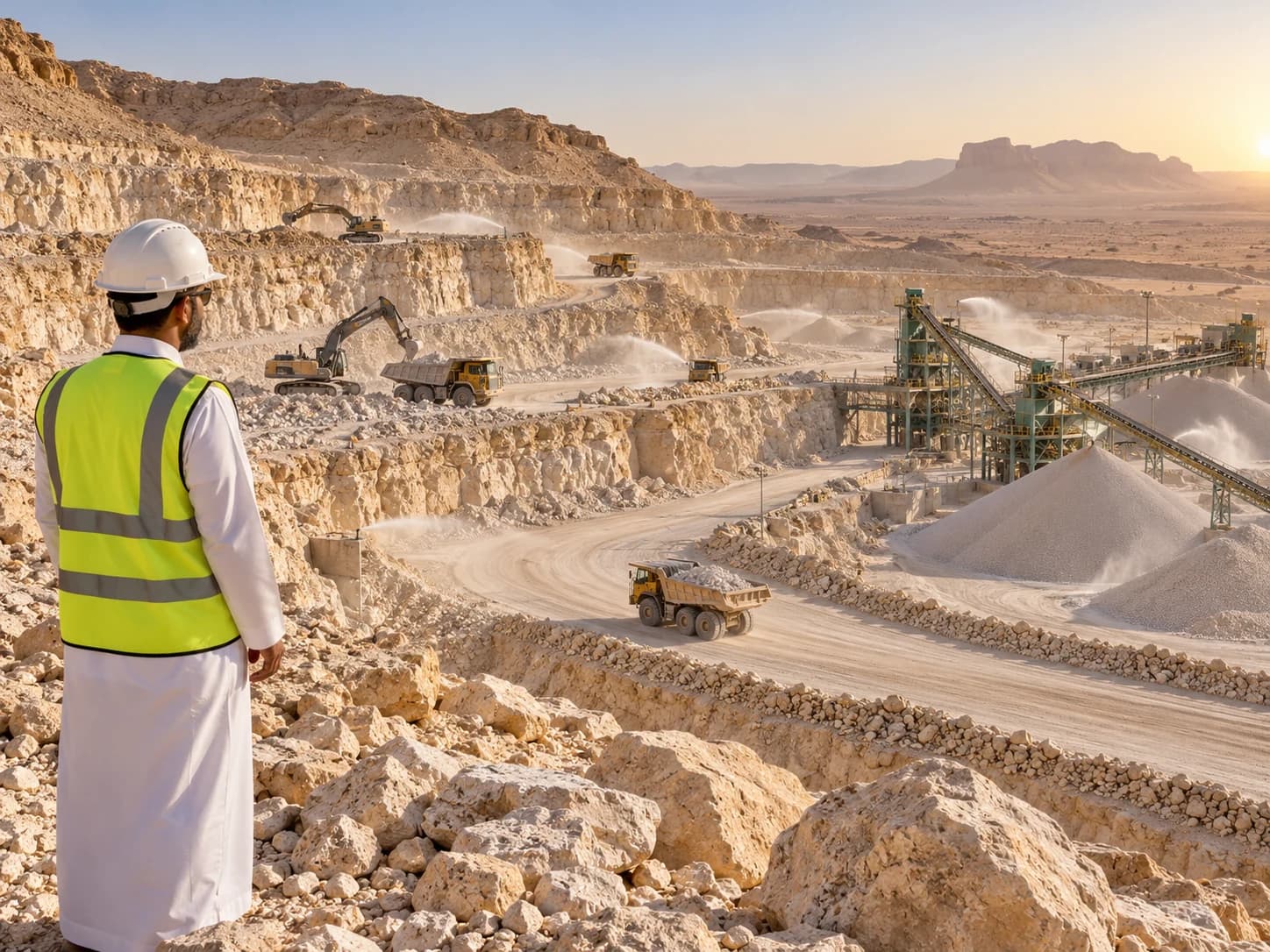
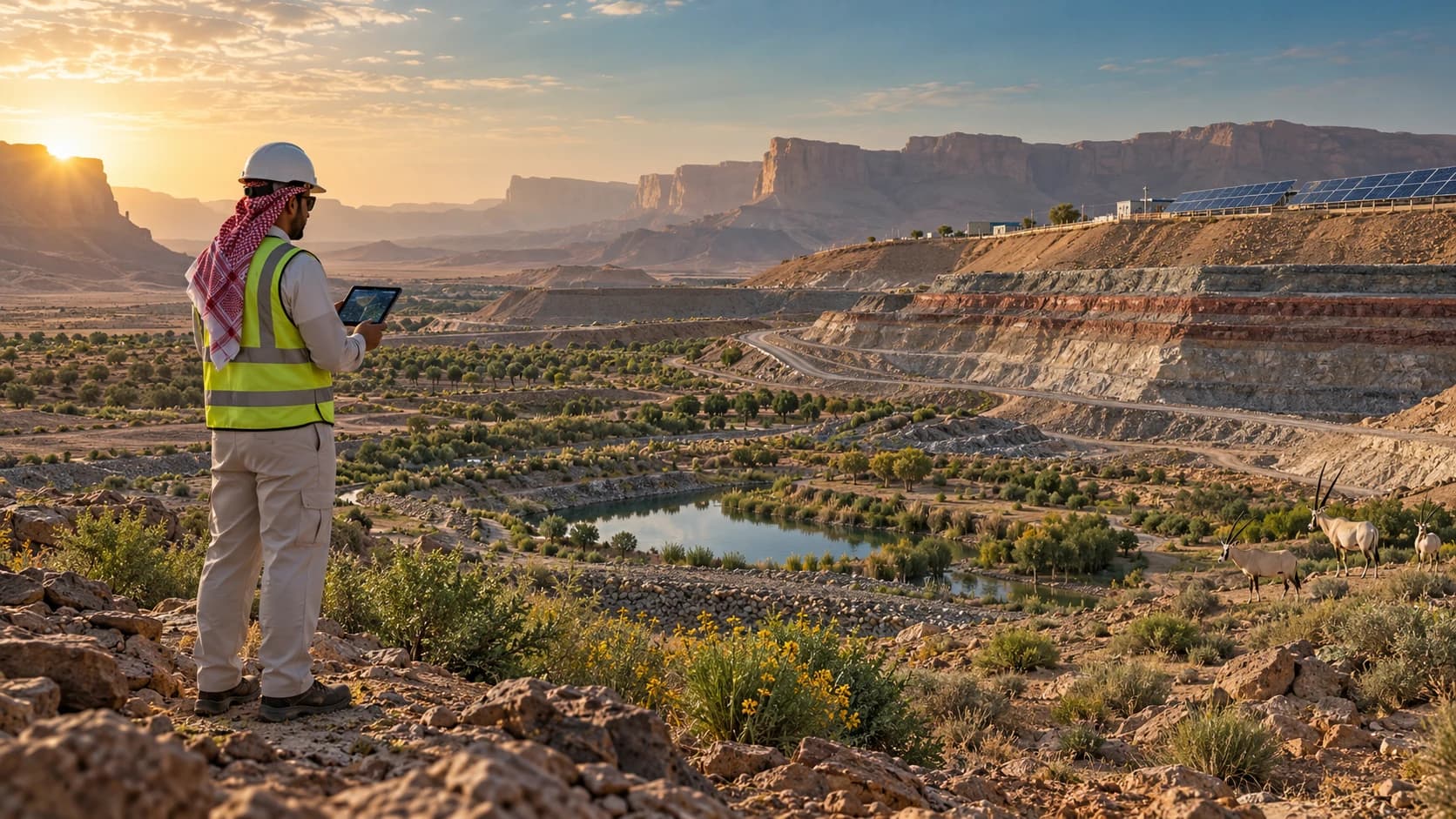
Photographs on this page are generated illustrations. They do not depict a specific mine, company, project, event or certified restoration site.
SAR 9.375 trillion
Estimated value of the Kingdom’s mineral wealth
- Period:
- Announced January 2024 (up 90% on the 2016 estimate of SAR 5 trillion)
- Scope:
- Estimate of mineral wealth — not proven reserves
SPA (8 June 2026) gives the same estimate as about US$2.5 trillion — a rounded conversion, not a separate valuation.
Source:Ministry of Industry and Mineral Resources — Mineral wealth estimates up 90% to more than SAR 9 trillion (opens in a new tab)· Announced January 2024 (page undated)· Last checked: 15 October 2026Source:Saudi Press Agency — Unlocking the Shield (opens in a new tab)· 8 Jun 2026· Last checked: 15 October 20265,651
Recorded mineralisation sites (3,058 non-metallic, 2,423 metallic, 170 both)
- Period:
- 2024
- Scope:
- Occurrences — not economically mineable deposits
Source:GASTAT — Mineral Resources Statistics 2024 (opens in a new tab)· 30 Nov 2025· Last checked: 15 October 20262,401
Mining licences recorded
- Period:
- 2024
- Scope:
- All licence types — not active mines or production sites
Source:GASTAT — Mineral Resources Statistics 2024 (opens in a new tab)· 30 Nov 2025· Last checked: 15 October 2026≈1.32 million km²
Estimated area of sedimentary cover rocks (about two-thirds of the Kingdom)
- Period:
- SGS reference page
- Scope:
- Geological extent — not a resource measure
Source:Saudi Geological Survey — The Neoproterozoic and Phanerozoic cover rocks (opens in a new tab)· Undated page· Last checked: 15 October 2026


GASTAT’s GDP and industrial-production series group “mining and quarrying” with crude oil and natural gas, so we do not present them as non-oil mining performance. The Mineral Resources Statistics release is the closest non-oil source.

Not shown: a count of “45 minerals” (not found on an official page), the SAR 240 billion GDP target, and national mining job, production or export totals — none could be confirmed with scope and base year in a current official source.

Data updated: 15 October 2026 · Sources · Source:Saudi Vision 2030 — Strategy for the Mining Sector (opens in a new tab)· Live page· Last checked: 15 October 2026
Natural resources and geology
The Saudi Geological Survey describes two broad settings. The Arabian Shield in the west — exposed from southern Jordan to Yemen and formed roughly 850–550 million years ago — is a primary source of metallic minerals; gold has been mined there for more than 3,000 years. To the east and north, sedimentary cover rocks host most industrial minerals.
Start with official data
The National Geological Database, run by the SGS since December 2021, is designed to give access to survey, exploration and drilling data, mineral occurrences and geological maps at 1:1,000,000 to 1:250,000. We do not reproduce maps, licensed areas or deposit boundaries here — official maps and licensing status change.
Illustrative image
Precious metals
Gold and silver are associated with the Arabian Shield. Both were named targets of the Ministry’s 10th exploration round (three belts, about 13,000 km²).
Gold
Evidence level: Named target in an official licensing roundMined in the Shield for more than 3,000 years (SGS); 10th-round target.
Source:Ministry of Industry and Mineral Resources — 10th exploration licensing round — three belts (opens in a new tab)· Undated page· Last checked: 15 October 2026Silver
Evidence level: Named target in an official licensing round10th-round target.
Source:Ministry of Industry and Mineral Resources — 10th exploration licensing round — three belts (opens in a new tab)· Undated page· Last checked: 15 October 2026
Investment pathways and major operators
Investors enter the sector in different ways, and each path carries different obligations. Requirements depend on the mineral, activity, site and investor type.
Direct exploration or mining
Hold a licence through Ta’adeen — often via a competitive round — and carry the technical, financial and closure obligations.
Joint ventures and technical partnerships
Combine capital, technology and local presence; check how each partner’s licence and registration obligations apply.
Mining services and equipment
Supply operators without holding a mining licence; commercial, labour and tax registrations still apply.
Processing and downstream manufacturing
Industrial and environmental permits usually matter more than a mining licence here.
Logistics, laboratories, maintenance and digital
Specialist services across the lifecycle, from assay to fleet maintenance and data platforms.


Mining lifecycle and opportunity areas
A mine moves through many stages before and after production. Each stage draws on different capabilities. These are opportunity areas to research — not offers, tenders, incentives or guaranteed returns.
- 1Geological data
- 2Reconnaissance
- 3Exploration
- 4Feasibility
- 5Licensing and financing
- 6Mine development
- 7Extraction and processing
- 8Domestic supply or export
- 9Rehabilitation and closure
12 of 12 opportunity areas
Geological and geospatial services
Mapping, remote sensing, data interpretation and modelling.
Geological dataReconnaissance & exploration
Opportunity area — not an offer
Drilling and sampling
Exploration drilling, core handling and field logistics.
Reconnaissance & explorationFeasibility, licensing & development
Opportunity area — not an offer
Laboratories and assay
Assay, metallurgical test work and quality control.
Reconnaissance & explorationExtraction & processing
Opportunity area — not an offer
Exploration and mine investment
Licence rounds, joint ventures and project development.
Reconnaissance & explorationFeasibility, licensing & development
Opportunity area — not an offer
Engineering, construction and power
Mine and plant engineering, construction, power and water supply.
Feasibility, licensing & development
Opportunity area — not an offer
Mining equipment and safety systems
Fleet, maintenance, protective equipment and digital safety tools.
Feasibility, licensing & developmentExtraction & processing
Opportunity area — not an offer
Processing and beneficiation
Concentration, refining and value-adding steps close to the mine.
Extraction & processing
Opportunity area — not an offer
Metals and fertilizer downstream
Manufacturing that uses domestic metals, phosphate and industrial minerals.
Extraction & processingDomestic supply & export
Opportunity area — not an offer
Water efficiency and environmental technology
Water recycling, dust control, tailings management and monitoring.
Extraction & processingRehabilitation & closure
Opportunity area — not an offer
Logistics and export services
Haulage, rail, port handling, storage and customs brokerage.
Domestic supply & export
Opportunity area — not an offer
Recycling and secondary materials
Recovering metals and materials from scrap and process residues.
Domestic supply & exportRehabilitation & closure
Opportunity area — not an offer
Rehabilitation and closure services
Closure planning, landform restoration and post-closure monitoring.
Rehabilitation & closure
Opportunity area — not an offer


How a potential investor begins due diligence
- 1
Select the commodity, activity and project stage.
- 2
Inspect official geological data in the National Geological Database.
- 3
Check current Ta’adeen licensing rounds, licence types and rules.
- 4
Assess your technical and financial capacity against the round or licence conditions.
- 5
Verify land, access and environmental conditions for the site.
- 6
Establish a Saudi entity and complete investment registration with MISA if required.
- 7
Follow the competent authority’s current application sequence.
Licensing rounds — status on Ta’adeen
Exploration Licensing Tender Rounds — Preliminary Plan 2026–2027
Listed as active
Source:Ta’adeen — Mining bids and licensing rounds (opens in a new tab)· Updated 21 Dec 2025· Last checked: 15 October 2026Round 11
Listed as active
Source:Ta’adeen — Mining bids and licensing rounds (opens in a new tab)· Updated 21 Dec 2025· Last checked: 15 October 2026Round 10 — three belts, about 13,000 km² (gold, silver, copper, zinc; nickel in one belt)
Listed as inactive; prequalification closed 15 Dec 2025
Source:Ministry of Industry and Mineral Resources — 10th exploration licensing round — three belts (opens in a new tab)· Undated page· Last checked: 15 October 2026Exploration Enablement Program — Wave 3 (with MISA)
Applications opened 1 Feb 2026; window extended 6 Apr 2026 — check for the current deadline
Source:Ta’adeen — News — Exploration Enablement Program, Wave 3 (opens in a new tab)· Opened 1 Feb 2026; extended 6 Apr 2026· Last checked: 15 October 2026
Major operators
Ma’aden (Saudi Arabian Mining Company)
A major Saudi mining operator and investor — not a regulator. Ma’aden describes its commitment to “responsibly harnessing the Kingdom’s mineral resources” and applies biodiversity standards from exploration to closure. Its current business-unit structure could not be confirmed on its website on 15 October 2026 — check its latest annual report.
Other licence winners, joint ventures and operators are not listed until a live Ministry or company source confirms their current status.
We do not state ownership percentages, tax holidays, royalty rates, incentives, financing or approval timelines — confirm each with the competent authority.
Licences and investment registration
The Ministry of Industry and Mineral Resources administers mining policy and licences. Digital licence services run through Ta’adeen, operated by the Saudi Mining Services Company (ESNAD) with the Ministry as partner. This is an orientation, not a legal interpretation.
The legal framework
The Mining Investment Law was issued by Royal Decree M/140 dated 19/10/1441H (11 June 2020) and has since been amended. It names reconnaissance, exploration and exploitation licences; exploitation licences include mining, small-mine, building-materials quarry and general-purpose licences. The law, its Executive Regulation and a Mining Investor Guide are published on Ta’adeen.
Licence types listed on Ta’adeen
- Reconnaissance licence
- Exploration licence
- Mining licence
- Small mining licence
- Building materials licence
- Surplus raw materials licence
- General purposes licence
Ta’adeen services: issue, renew, transfer and amend licences, periodic reports, and the Mining Infrastructure Enablement Initiative.
A licence pathway, step by step
- 1
Define the project
Confirm the mineral, activity and proposed project stage.
Source:Saudi Geological Survey — National Geological Database — about (opens in a new tab)· Launched 8 Dec 2021· Last checked: 15 October 2026 - 2
Read the current rules
Review the Mining Investment Law, its Executive Regulation and Ministry guidance.
Source:Ta’adeen — Rules and regulations (law, executive regulation, investor guide) (opens in a new tab)· Documents dated 25 May 2025· Last checked: 15 October 2026 - 3
Check Ta’adeen
Licence category, available areas, competition rounds, service requirements, fees and submission route.
Source:Ta’adeen — License types (opens in a new tab)· Live page· Last checked: 15 October 2026 - 4
Qualify the applicant
Confirm the applicant entity, technical and financial qualifications, data-room and bid requirements, and licence obligations.
Source:Ta’adeen — Mining bids and licensing rounds (opens in a new tab)· Updated 21 Dec 2025· Last checked: 15 October 2026 - 5
Coordinate other approvals
Environmental, site, infrastructure, safety, labour and downstream-plant approvals with the competent authorities.
Source:National Center for Environmental Compliance — Environmental licensing (opens in a new tab)· Live page· Last checked: 15 October 2026 - 6
Maintain the licence
Reporting, fees, monitoring, closure and rehabilitation obligations for the life of the licence.
Source:Ta’adeen — Services (opens in a new tab)· Live page· Last checked: 15 October 2026
Investment registration is a separate question
Registering an investment with MISA is not a mining licence. Under the Investment Law and its Implementing Regulations, foreign investors register their investment for activities open to investment; MISA’s 13th-edition Investor Guide (03–2026) describes this registration. The Ta’adeen Mining Investor Guide (dated January 2022) still refers to a MISA licence — check MISA’s current service before you apply. We found no MISA source naming mining as an excluded activity; confirm your activity code with MISA.
Government, research, training and industry directory
Who does what — as each body describes itself. Relevance does not mean a body can approve your project, and The True KSA has no partnership with any of them.
16 of 16 institutions
Government & regulator
Ministry of Industry and Mineral Resources
Mining-sector policy and mining licences; organiser of the Future Minerals Forum.
The exact name of the deputy ministry for mining could not be confirmed online — TODO.
Investors · Suppliers & service providers · Researchers
Official site: Ministry of Industry and Mineral Resources (opens in a new tab)Last checked: 15 October 2026
Licensing & information platform
Ta’adeen
Official digital portal for mining-sector services: licences, rounds and a mining map. Operated by ESNAD.
Investors · Suppliers & service providers
Official site: Ta’adeen (opens in a new tab)Last checked: 15 October 2026
Geological data
Saudi Geological Survey
“Responsible for all specialized earth science works in the Kingdom.”
Investors · Researchers
Official site: Saudi Geological Survey (opens in a new tab)Last checked: 15 October 2026
Geological data
National Geological Database
SGS platform for survey, exploration and drilling data, mineral occurrences and maps.
Investors · Researchers · Suppliers & service providers
Official site: National Geological Database (opens in a new tab)Last checked: 15 October 2026
Government & regulator
Ministry of Investment (MISA)
Investment registration and the Investor Guide; publishes the Investment Law and regulations.
Investors
Official site: Ministry of Investment (MISA) (opens in a new tab)Last checked: 15 October 2026
Government & regulator
National Center for Environmental Compliance
Environmental licensing and permits for facilities; reviews environmental impact assessments.
Investors · Suppliers & service providers
Official site: National Center for Environmental Compliance (opens in a new tab)Last checked: 15 October 2026
Licensing & information platform
NIDLP — Daleel platform
Investor information on NIDLP sector value propositions, including mining.
Investors
Official site: NIDLP — Daleel platform (opens in a new tab)Last checked: 15 October 2026
Government & regulator
ZATCA
Customs, export declarations, classification, taxes and zakat.
Traders & exporters · Investors
Official site: ZATCA (opens in a new tab)Last checked: 15 October 2026
Government & regulator
Saudi Export Development Authority (Saudi Exports)
Export guidance and exporter services through its e-services portal.
Traders & exporters
Official site: Saudi Export Development Authority (Saudi Exports) (opens in a new tab)Last checked: 15 October 2026
Statistics
GASTAT
Official statistics, including Mineral Resources Statistics and trade data.
Researchers · Investors · Traders & exporters
Official site: GASTAT (opens in a new tab)Last checked: 15 October 2026
Government & regulator
Royal Commission for Jubail and Yanbu
Runs four industrial cities, including Ras Al Khair City for Mining Industries.
Investors · Suppliers & service providers
Official site: Royal Commission for Jubail and Yanbu (opens in a new tab)Last checked: 15 October 2026
Operator
Ma’aden
Saudi mining operator and investor — not a government body.
Suppliers & service providers · Students & workers
Official site: Ma’aden (opens in a new tab)Last checked: 15 October 2026
Training & research
Saudi Mining Polytechnic
Technical training for national talent in mining, from exploration to plant operations.
Students & workers
Official site: Saudi Mining Polytechnic (opens in a new tab)Last checked: 15 October 2026
Training & research
King Abdulaziz University — School of Mines
Academic structure approved in July 2026 (Earth Sciences & Geophysics; Mining Engineering).
Announced academic initiative — establishment still in progress.
Students & workers · Researchers
Official site: King Abdulaziz University — School of Mines (opens in a new tab)Last checked: 15 October 2026
Training & research
KAUST — industry and mining programs with MIM
Agreement (Nov 2024) for undergraduate, master’s and doctoral programs for industry and mining.
Students & workers · Researchers
Official site: KAUST — industry and mining programs with MIM (opens in a new tab)Last checked: 15 October 2026
Event
Future Minerals Forum
Annual international forum in Riyadh organised by MIM.
Investors · Suppliers & service providers · Researchers
Official site: Future Minerals Forum (opens in a new tab)Last checked: 15 October 2026


Not listed until verified on an official site: the Higher Institute for Mining Resources Training, the Saudi Mining Association, the Riyadh Chamber mining committee and any MODON mining-city link.
Check before you invest
An orientation checklist, not legal advice. Approvals differ by activity, commodity, site, capacity and investor type — not every project needs every item. Confirm your sequence with the authorities and qualified advisers.
Mining Investment Law and licence conditions
- What to check
- Licence category, conditions and the current Executive Regulation.
- When it may apply
- Any reconnaissance, exploration or exploitation activity.
Investment registration
- What to check
- MISA registration and activity classification.
- When it may apply
- Foreign investors, where applicable.
Land, site and infrastructure
- What to check
- Mineral-zone status, access, site and infrastructure approvals.
- When it may apply
- Field work and any site development.
Environmental assessment and permits
- What to check
- Facility category and environmental impact assessment through NCEC; scope depends on current rules and project facts.
- When it may apply
- Exploration with field impact, mining and processing.
Water, waste, tailings and heritage
- What to check
- Water sourcing and discharge, waste and tailings, dust and emissions, biodiversity, cultural heritage and reclamation.
- When it may apply
- Operating sites and plants.
Feasibility, safety and workforce
- What to check
- Technical feasibility, safety management, emergency planning, training, employment and applicable Saudization rules.
- When it may apply
- Development and operation.
Industrial permits
- What to check
- Industrial licence for processing or manufacturing facilities.
- When it may apply
- Processing and downstream plants.
Tax, zakat, fees and royalties
- What to check
- Current schedules from the competent authority; financial reporting.
- When it may apply
- All licence holders and operating companies.
Export approvals and customs
- What to check
- Mineral export conditions under the law and regulation, tariff classification, origin documents, declarations and transport.
- When it may apply
- Exporting minerals, ores or products.
Rehabilitation and closure
- What to check
- Reclamation and closure plan and its financial guarantee.
- When it may apply
- Exploitation licences, for the life of the licence.
Public procurement and local-content rules apply only when the project or buyer makes them applicable.
Trade, processing and market access
Ores, concentrates, refined metals, fertilizers and manufactured mineral products are classified, regulated and counted differently. Choose a product class to see what to check.
Ores and concentrates
Raw or upgraded mineral material. The Mining Investment Law covers exporting minerals and ores for commercial purposes, and the Executive Regulation sets export conditions and a request procedure.
- Mineral export conditions and request procedure (MIM / Ta’adeen)
- Certificate of analysis
- Transport document for mineral ores
For every shipment, check
- HS code and exact product description
- Whether the goods are prohibited or restricted for export
- Required export approvals and the customs declaration
- Commercial invoice, packing list and bill of lading or manifest
- Certificate of origin and any commodity-specific certificates
- Destination tariff and rules of origin — an FTA benefit is never automatic
ZATCA notes that regulations ban or limit the export of several goods, including some natural resources, and asks exporters to check its list of restricted goods.
Illustrative imageHow to check a trade claim
Ask which product classification, period and source a figure uses. Not all non-oil exports are mining; aluminium and fertilizers are processed products; and “mining and quarrying” exports on some dashboards include crude oil. Compare like with like, and use GASTAT tables for the latest period.
Rail, port and industrial-city routes are not mapped here. Ras Al Khair City for Mining Industries (RCJY) is one verified industrial city for mining industries; confirm routes with the operator or government source.
Skills, local capability and responsible mining
Mining needs a wide range of skills — in the field, in plants and in offices. We do not publish national mining employment totals or nationalisation quotas; none were confirmed with a source and period.
Roles across the sector
- Geologists
- Mining engineers
- Drillers
- Surveyors
- Data specialists
- Metallurgists
- Plant operators
- Electrical maintenance
- Mechanical maintenance
- Environmental specialists
- Safety professionals
- Logistics
- Finance
- Local suppliers
University pathways
- King Abdulaziz University approved the academic structure of its School of Mines on 24 July 2026, replacing the Faculty of Earth Sciences — an announced initiative still being established.Source:King Abdulaziz University — Academic structure approved for the School of Mines (opens in a new tab)· 24 Jul 2026· Last checked: 15 October 2026
- KAUST and MIM agreed in November 2024 to launch undergraduate, master’s and doctoral programs for industry and mining.Source:KAUST — KAUST and MIM agreement on industry and mining programs (opens in a new tab)· 25 Nov 2024· Last checked: 15 October 2026
Saudi Mining Polytechnic programs
- Surface Mining
- Underground Mining
- Mineral Exploration
- Plant Operations
- Mining Laboratory Technology
- Cement Manufacturing Technology
- Electrical Maintenance
- Mechanical Maintenance
- Industrial Security Operations
 Illustrative image
Responsible mining and mine closure
Sustainable mining starts before the first drill hole: environmental baseline data, water efficiency, monitoring, worker health and safety, waste and tailings controls, community considerations and progressive rehabilitation. The Mining Investment Law requires a plan for site reclamation and closure and a financial guarantee for it, and the Executive Regulation sets out how the plan is submitted and reviewed.
- Environmental baseline and monitoring
- Water efficiency and discharge control
- Worker health and safety
- Progressive rehabilitation and closure planning
Future Minerals Forum
The Ministry of Industry and Mineral Resources organises the Future Minerals Forum in Riyadh. The fifth edition took place on 13–15 January 2026 at the King Abdulaziz International Conference Center. The official site lists FMF 2027 for January 2027 but shows two different date ranges — confirm on the official site before planning travel.
Illustrative imageSources and verification
Every key figure, with its period, publisher, link and caveat. Checked 15 October 2026; next scheduled review 15 January 2027. Official sources only — secondary reports were used to locate issues, never as final evidence.
| Claim or metric | Figure | Geography | Period | Published | Source | Caveat | Next review |
|---|---|---|---|---|---|---|---|
| Estimated mineral wealth | SAR 9.375 trillion | Saudi Arabia | 2024 estimate | Jan 2024 | Ministry of Industry and Mineral Resources — Mineral wealth estimates up 90% to more than SAR 9 trillion (opens in a new tab) | Estimate of wealth, not proven reserves. | 15 January 2027 |
| Mineral endowment in US dollars | ≈US$2.5 trillion | Saudi Arabia | Same estimate | 8 Jun 2026 | Saudi Press Agency — Unlocking the Shield (opens in a new tab) | Rounded conversion of the SAR estimate. | 15 January 2027 |
| Mineralisation sites | 5,651 | Saudi Arabia | 2024 | 30 Nov 2025 | GASTAT — Mineral Resources Statistics 2024 (opens in a new tab) | Occurrences, not mineable deposits. | 15 January 2027 |
| Mining licences | 2,401 | Saudi Arabia | 2024 | 30 Nov 2025 | GASTAT — Mineral Resources Statistics 2024 (opens in a new tab) | All licence types; not active mines. | 15 January 2027 |
| Aluminium exports | ≈283,000 t | Saudi exports | 2024 | 30 Nov 2025 | GASTAT — Mineral Resources Statistics 2024 (opens in a new tab) | Processed metal, not ore. | 15 January 2027 |
| Phosphate fertilizer exports | ≈5.7 million t | Saudi exports | 2024 | 30 Nov 2025 | GASTAT — Mineral Resources Statistics 2024 (opens in a new tab) | Chemical product, not ore. | 15 January 2027 |
| Lead exports / zinc imports | ≈59,000 t / ≈88,000 t | Saudi trade | 2024 | 30 Nov 2025 | GASTAT — Mineral Resources Statistics 2024 (opens in a new tab) | Trade flows, not production. | 15 January 2027 |
| Sedimentary cover area | ≈1,320,000 km² | Saudi Arabia | Reference | Undated | Saudi Geological Survey — The Neoproterozoic and Phanerozoic cover rocks (opens in a new tab) | Geological extent only. | 15 January 2027 |
| 10th exploration round | 3 belts, ≈13,000 km² | Arabian Shield belts | Prequalification to 15 Dec 2025 | Undated | Ministry of Industry and Mineral Resources — 10th exploration licensing round — three belts (opens in a new tab) | Licence area, not discovered deposits. | 15 January 2027 |
| Mining Investment Law | Royal Decree M/140 | Saudi Arabia | In force, amended | 11 Jun 2020 | Bureau of Experts at the Council of Ministers — Mining Investment Law (Royal Decree M/140) (opens in a new tab) | Read the current consolidated text. | 15 January 2027 |
| Mining & quarrying industrial index | +13.0% y/y | Saudi Arabia | February 2026 | 9 Apr 2026 | GASTAT — Industrial Production Index, February 2026 (opens in a new tab) | Includes crude oil and gas — not non-oil mining. | 15 January 2027 |
Not shown: a count of “45 minerals” (not found on an official page), the SAR 240 billion GDP target, and national mining job, production or export totals — none could be confirmed with scope and base year in a current official source.
Photographs on this page are generated illustrations. They do not depict a specific mine, company, project, event or certified restoration site. The True KSA is an independent information platform. It does not represent Saudi ministries and does not provide legal, tax, investment or engineering advice.
Have a question about Saudi mining?
Ask the KSA Concierge for orientation and continue to the official sources. The True KSA cannot secure permits, arrange investments or provide government services.