
Skip to content
Kingdom of Saudi Arabia
The True KSA — Business, Tourism, Economy, Culture

The True KSA · Energy & petrochemicals

Energy, industry and opportunity in Saudi Arabia

Explore the Kingdom’s connected energy value chain — from oil and gas to refining, chemicals, industrial supply chains and international trade. Follow the data, companies, investment routes and official requirements behind each opportunity.

The True KSA is an independent information platform, not a government agency. This page is not legal, tax or investment advice. Last checked: 15 October 2026

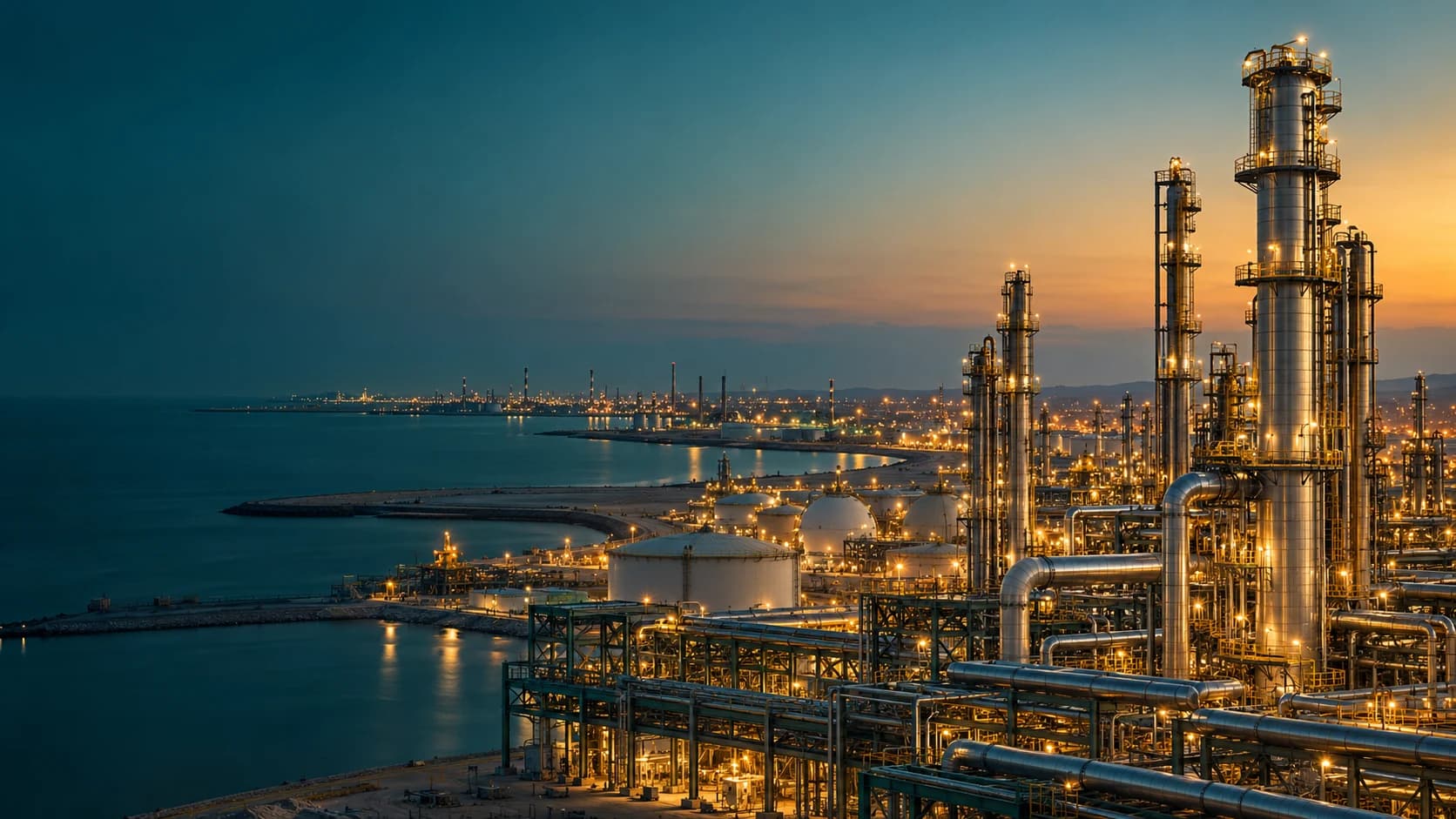
Illustrative image: a petrochemical refinery beside the Gulf at dusk

Illustrative image

At a glance

Energy and petrochemicals form a connected industrial ecosystem. Each figure below has its own period and scope — national statistics and company disclosures are kept apart so you can compare like with like.

First row: national statistics (GASTAT). Second row: Saudi Aramco company disclosures — not national totals.

Oil, gas and the value chain

The value chain links upstream oil and gas, gas processing and NGLs, refining, basic chemicals, polymers and specialty products, industrial manufacturing, storage, ports and export services. Different companies operate in different stages; this diagram is an explainer, not one company’s footprint.

  1. 1 / 6

    Upstream

    Exploration and production of crude oil and gas.

    Feeds refineries and gas plants

  2. 2 / 6

    Gas & NGLs

    Processing gas into fuel and natural-gas liquids.

    Supplies power and chemical feedstock

  3. 3 / 6

    Refining

    Turning crude into fuels and refinery streams.

    Some streams feed chemicals

  4. 4 / 6

    Base chemicals

    Olefins, aromatics and other building blocks.

    Converted into polymers

  5. 5 / 6

    Specialty & downstream

    Polymers, specialty chemicals and manufactured goods.

    Supplies local industry and export

  6. 6 / 6

    Logistics & export

    Storage, pipelines, terminals and shipping.

    Reaches regional and global markets

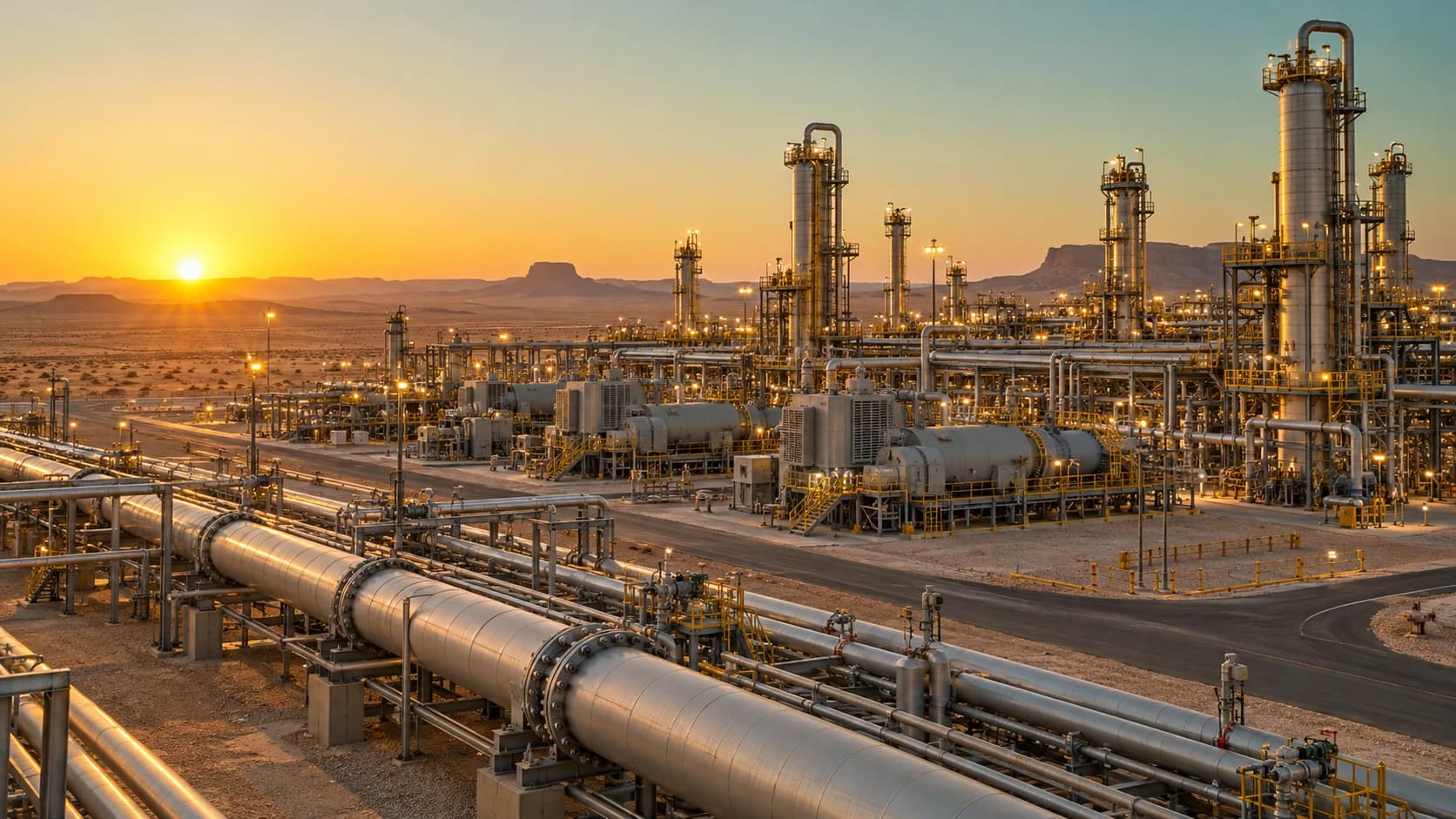
Illustrative image: a gas processing facility in a desert landscape at sunriseIllustrative image
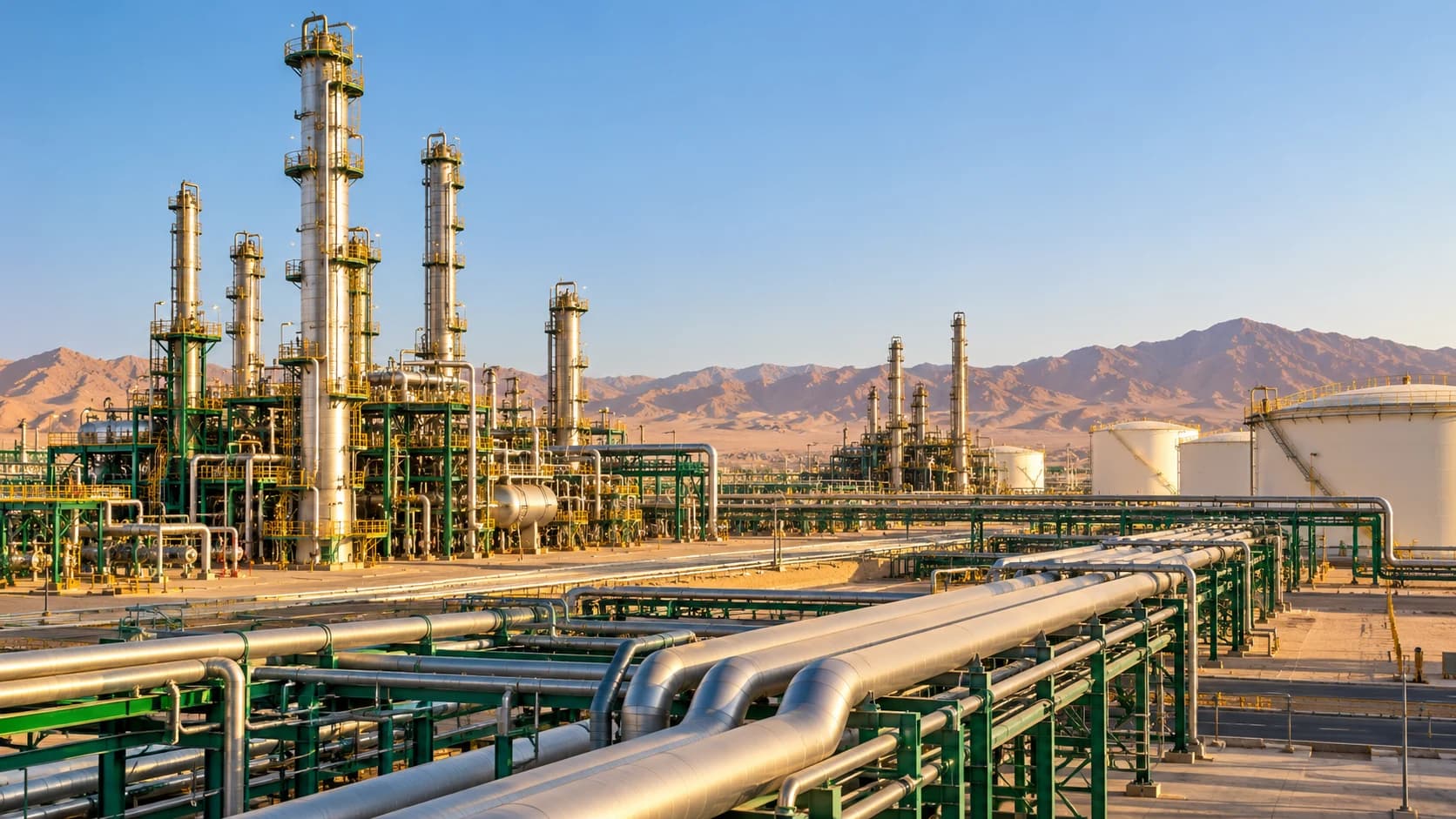
Illustrative image: refinery process towers and pipelinesIllustrative image

Turning resources into industrial value

Saudi projects connect feedstock, refining, chemicals, manufacturing and export logistics. Explore the operators, joint-venture structures, supplier programmes and official approvals behind each part of the chain.

Explore companies & projects

Refinery directory

Capacities are shown with their basis. Most use OPEC’s 2024 nameplate table carried in the research pack — we could not re-open that table on 15 October 2026, so treat those values as a dated baseline. Nameplate is not throughput, net equity capacity or current output.

Location
Ownership

9 of 9 refineries

Chemicals & materials

Feedstock from oil and gas becomes base chemicals, polymers and specialty products, then goods made by downstream manufacturers. Integrated sites combine refining and chemicals; others focus on one stage.

Illustrative image: a process technician walking through an industrial facilityIllustrative image
  • Base chemicals and polymers

    Large integrated complexes, often joint ventures, mainly in industrial cities.

  • Specialty and performance chemicals

    Smaller volumes and higher technical requirements for products and customers.

  • Downstream manufacturing

    Converters and manufacturers using local materials — check industrial licensing, standards and site rules.

Trade and market access

Three different measures, three different periods — shown separately and never added together.

67.5%

Petroleum share of goods exports

Data period:
Q4 2025
Scope:
Quarterly share of total goods exports
Reported by:GASTAT — International trade, Q4 2025 (opens in a new tab)· 25 Feb 2026· Last checked: 15 October 2026

SAR 6.0bn

Chemical industry products exported — 26.4% of non-oil exports

Data period:
April 2025
Scope:
One month only
Reported by:GASTAT — International trade, April 2025 (opens in a new tab)· 25 Jun 2025· Last checked: 15 October 2026

Annual petroleum export value: the pack cites OPEC’s 2024 figure, but we could not re-open the OPEC bulletin on 15 October 2026, so no annual value is shown. OPEC released a 2026 edition on 29 April 2026. Reported by:OPEC — Annual Statistical Bulletin 2025 (PDF) (opens in a new tab)· 2025 edition; a 2026 edition was released 29 Apr 2026· Could not be read 15 Oct 2026

Illustrative image: an export terminal with storage tanks and a cargo vesselIllustrative image

Trade agreements and origin

The five agreements GAFT lists as existing (checked 15 Oct 2026). Dates are as shown by GAFT, which does not say whether they are signing or entry-into-force dates.

Agreement type

5 agreements

  • Free trade agreement

    GCC Free Trade Agreement with Singapore

    Date shown by GAFT
    1 Sep 2013
    Partners and scope
    GCC and Singapore; goods

    Rules of origin: Preference depends on the tariff line and rules of origin.

  • Free trade agreement

    GCC Free Trade Agreement with EFTA countries

    Date shown by GAFT
    1 Jul 2015
    Partners and scope
    GCC and EFTA states; goods

    Rules of origin: Preference depends on the tariff line, origin and current schedule.

  • Regional economic framework

    GCC Economic Agreement

    Date shown by GAFT
    1 Nov 1981
    Partners and scope
    GCC member states

    Rules of origin: A framework — do not assume every product is duty-free; check the GCC common customs rules.

  • Arab goods trade arrangement

    Agreement on Facilitating and Developing Inter-Arab Trade (Greater Arab Free Trade Area)

    Date shown by GAFT
    1 Jan 1981
    Partners and scope
    Participating Arab states; goods

    Rules of origin: Check origin, exclusions, certificates and customs procedure.

  • Services agreement

    Agreement on Liberalization of Trade in Services among Arab States

    Date shown by GAFT
    14 Oct 2019
    Partners and scope
    Participating Arab states; services

    Rules of origin: A services agreement — not a goods tariff agreement for hydrocarbons or chemicals.

Reported by:General Authority for Foreign Trade (GAFT) — Trade agreements (opens in a new tab)· Live page· Last checked: 15 October 2026

A listed agreement does not make every energy product tariff-free. Confirm the current agreement, tariff schedule, HS code, product exclusions, origin rule, certification and customs procedure with GAFT and ZATCA. GCC agreements are not Saudi-only bilateral deals.

Investment pathways

Check activity eligibility, registration, licensing, site, environmental, tax, employment and local-content requirements before committing capital. Approvals differ by activity, ownership structure and location.

  • Foreign greenfield

    Confirm MISA registration, activity code and any restriction, then commercial registration and sector approvals.

  • Joint venture

    Ownership and governance, licensing, competition, funding, tax, customs, local content, labour and environmental diligence.

  • Acquisition or minority stake

    Verify the target’s licences, liabilities and change-of-control conditions.

  • Listed companies

    Shares of listed companies are bought through the regulated capital market under CMA rules — separate from setting up a company.

  • Local supplier or industrial manufacturing

    Site, utilities, industrial licence, environmental classification, product standards, offtake and localization.

  • Licensed downstream production

    Feedstock arrangements, industrial and environmental permits and product standards for the specific product.

MISA and industrial licensing route, in plain terms

  1. 1

    Check the activity is available to foreign investors and register the investment with MISA.

    Ministry of Investment (MISA) (opens in a new tab)
  2. 2

    Register the company with the Ministry of Commerce.

    Ministry of Commerce — company registration (opens in a new tab)
  3. 3

    Apply for the industrial licence for a manufacturing activity.

    Ministry of Industry and Mineral Resources (opens in a new tab)
  4. 4

    Secure a site with the relevant industrial-city authority.

    Royal Commission for Jubail and Yanbu (RCJY) (opens in a new tab)
  5. 5

    Obtain the environmental permit for your project classification.

    National Center for Environmental Compliance (NCEC) (opens in a new tab)
  6. 6

    Register for tax, Zakat and VAT as applicable; set up employment and social insurance.

    Zakat, Tax and Customs Authority (ZATCA) (opens in a new tab)

A planning outline, not a complete permit list. MISA registration alone is not permission to operate.

Reported by:Ministry of Investment (MISA) — Investor Guide, 13th edition (PDF) (opens in a new tab)· 02–2026· Last checked: 15 October 2026Reported by:Ministry of Investment (MISA) — Updated Investment Law (opens in a new tab)· Published 13 Aug 2024; updated 19 Sep 2026· Last checked: 15 October 2026

Investment evidence — kept separate

Four measures that must not be added together: realized FDI flows, announced project value, company annual capex and joint-venture ownership shares. No comparable sector-only energy/petrochemical FDI total is available from the sources we checked.

SAR 19.1bn

Net FDI inflows to the whole Saudi economy

Data period:
Q2 2026
Scope:
All activities — not energy or petrochemicals
Reported by:GASTAT — Foreign direct investment, Q2 2026 (opens in a new tab)· 30 Sep 2026· Last checked: 15 October 2026

SAR 190.4bn

Saudi Aramco capital expenditure

Data period:
2025
Scope:
Company-wide — not a sector or domestic investment total, and not FDI
Reported by:Saudi Aramco — Annual Report 2025 (PDF) (opens in a new tab)· FY 2025· Last checked: 15 October 2026

Never add these together

  • Realized FDI flows (national, all activities)
  • Announced project values
  • Company annual capex
  • Joint-venture ownership shares

A national FDI release covers every activity; a company’s capex can be spent at home or abroad; an announced project value is not money already invested; an ownership share is a structure, not a flow.

Illustrative image: Saudi and international energy professionals reviewing a projectIllustrative image

Joint venture · Jubail

Case study: Sadara

Sadara Chemical Company is a joint venture of Saudi Aramco (65%) and Dow (35%) in Jubail’s PlasChem Park, with 26 integrated manufacturing plants and more than 3 million tonnes of plastics and chemicals a year, according to Sadara. Ownership shares are a structure, not an annual investment flow.

A project-value figure circulating in media was not found on an official Sadara or partner page, so it is not shown.

Reported by:Sadara Chemical Company — Sadara website (opens in a new tab)· Live page· Last checked: 15 October 2026Reported by:Saudi Aramco — Annual Report 2025 (PDF) (opens in a new tab)· FY 2025· Last checked: 15 October 2026Reported by:Dow Inc. — Form 10-K 2025 (SEC) (opens in a new tab)· FY 2025· Last checked: 15 October 2026

Jobs, skills and local content

Localization can strengthen procurement, supply chains, skills and manufacturing. The measures below come from different sources with different boundaries.

Illustrative image: a Saudi engineer and colleague reviewing industrial control screensIllustrative image

National statistics by activity

GASTAT publishes employee tables by nationality and economic activity, but on 15 October 2026 we could not read activity-level rows for crude oil and gas extraction, refined petroleum, chemicals or manufacturing, and the Q2 2026 labour-market release has no industry breakdown. We therefore publish no Saudi/non-Saudi counts by activity — and no combined sector total. Open the GASTAT table for the latest rows.

Reported by:GASTAT — Employees by nationality and economic activity (opens in a new tab)· Table data not readable on 15 Oct 2026· Could not be read 15 Oct 2026Reported by:GASTAT — Labour market statistics, Q2 2026 (opens in a new tab)· 30 Sep 2026· Last checked: 15 October 2026

Company and programme measures

  • 90.9%

    Saudi nationals in Saudi Aramco’s workforce (2025)

    Scope: Aramco employees only

  • 70%

    Aramco procurement spend contributing to local content (start of 2026); goal 75%

    Scope: iktva — Aramco’s supplier programme

  • ~200,000

    Direct and indirect jobs created and sustained by iktva since 2015

    Scope: Aramco estimate — not national employment

Reported by:Saudi Aramco — Sustainability report — growing societal value (opens in a new tab)· 2025· Last checked: 15 October 2026Reported by:Saudi Aramco — iktva programme (opens in a new tab)· Live page, figures as of start of 2026· Last checked: 15 October 2026

iktva and LCGPA are different

iktva is Aramco’s own supplier programme. Local-content rules in government procurement are set by the Local Content and Government Procurement Authority (LCGPA) — a separate, government mechanism.

Illustrative image: a technician inspecting precision-machined industrial componentsIllustrative image

Tax and public contribution

Tax treatment depends on activity, ownership, tax residence, structure, the payment and the law in force. The rates below are as ZATCA publishes them; they do not tell you which applies to your facts.

Informational overview only. Confirm the current rule and your facts with ZATCA and a qualified adviser.

Public contribution — one company’s disclosure

Income taxes and zakat paid
SAR 197,282m
Data period: 2025 · Scope: Saudi Aramco only
Royalties paid
SAR 139,581m
Data period: 2025 · Scope: Saudi Aramco only

Saudi Aramco, statutory amounts paid in 2025 (legal section of the 2025 annual report). Amounts paid differ from the income-statement tax expense. Company-only — excludes dividends and is not the energy sector’s total contribution.

Authorities and approvals

Roles in short, why you may need each body, and the official link. This is not a complete permit list — approvals depend on activity, location, project and ownership.

Key players and flagship cases

Evidence-backed profiles with status. Operating assets, construction projects and studies are labelled differently; ownership is verify-before-use information.

Company type

Industrial suppliers are covered under Jobs & local content (iktva and LCGPA).

16 of 16 profiles

Sources and verification

Last checked 15 October 2026. Company figures and national statistics are labelled separately. Refresh time-sensitive data, ownership, tax and trade-policy material before relying on it.

National statistics

Company disclosure

Regulator / authority

International body

Not published pending verification: annual petroleum export value (OPEC); per-refinery capacities beyond operator statements (OPEC baseline shown and labelled); activity-level employment by nationality (GASTAT); the Sadara project value; Jazan refinery operator. No sector-wide FDI, jobs, tax or capacity total is published.

Last checked: 15 October 2026 · The True KSA is an independent information platform, not a government agency. This page is not legal, tax or investment advice.

Planning a project, a supplier partnership or a business visit?

Talk with The True KSA Concierge and continue to verified official sources. The concierge is an informational contact option, not official advice.

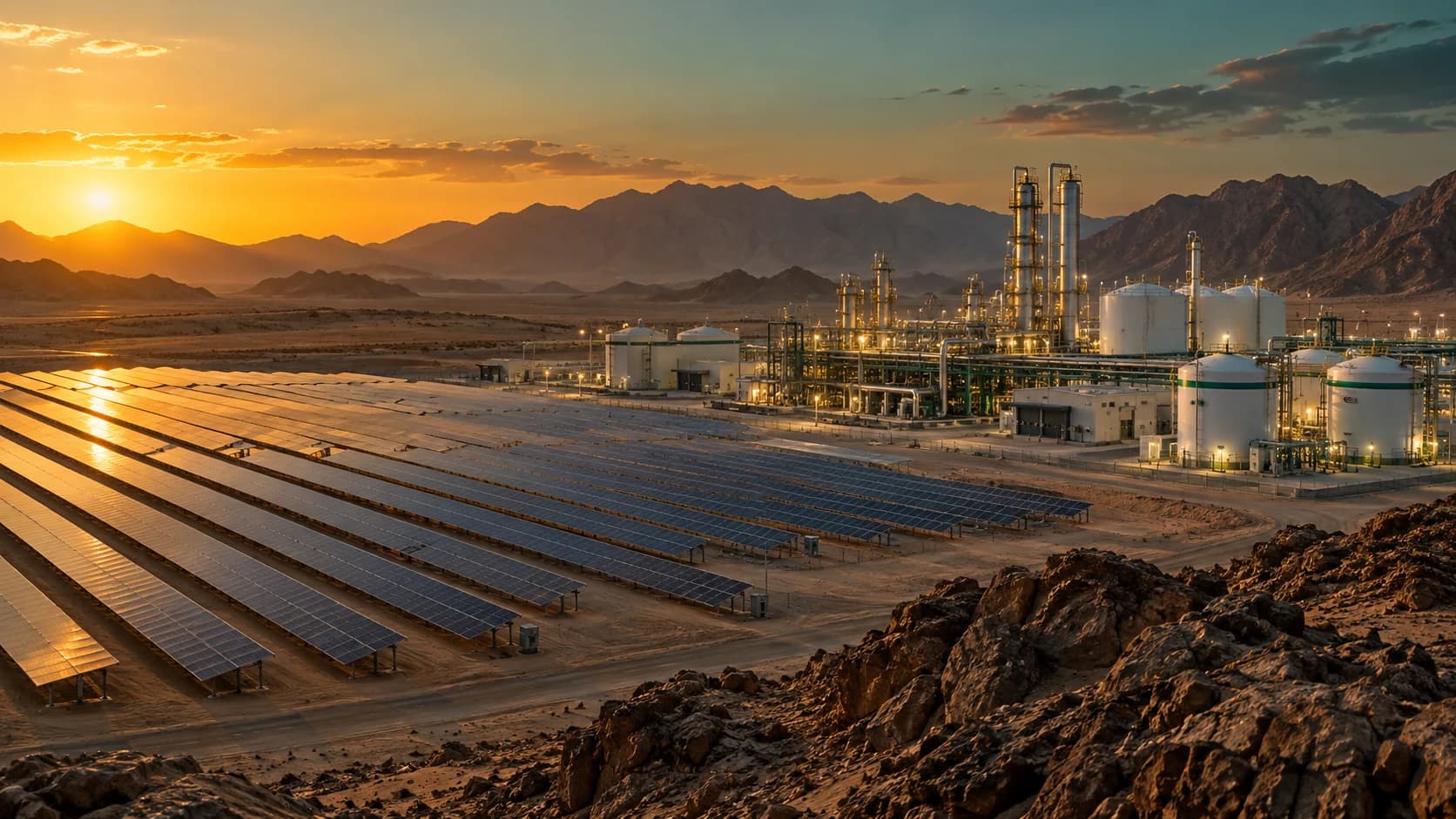
Illustrative image: solar panels beside an industrial facility in the desertIllustrative image

Related pages